Astronomers Capture First-Ever Image of a Black Hole’s Magnetic Field":
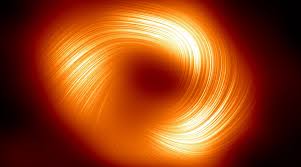
Astronomers Capture First-Ever Image of a Black Hole’s Magnetic Field":
In a historic breakthrough, astronomers have captured the first-ever image of a black hole’s magnetic field, providing unprecedented insight into one of the most mysterious and powerful forces in the universe. This achievement opens a new window into understanding how black holes interact with their surroundings and influence galaxy evolution.
Black holes, regions of spacetime with gravitational pulls so intense that nothing can escape, have fascinated scientists and the public alike for decades. While the first direct image of a black hole’s event horizon was captured in 2019, the detailed study of its magnetic fields remained elusive—until now. These magnetic fields are believed to play a critical role in shaping the behavior of matter around black holes, including the formation of high-speed jets that can extend thousands of light-years into space.
Using a global network of radio telescopes known as the Event Horizon Telescope (EHT), researchers focused on the supermassive black hole at the center of the galaxy M87. By analyzing polarized light—light waves oscillating in particular directions—they were able to map the magnetic field lines around the black hole’s event horizon for the first time. This technique revealed a swirling, twisted magnetic field structure, providing direct evidence of how these fields can control the flow of hot gas and influence jet formation.
The image confirms long-held theories about the connection between magnetic fields and black hole jets, which are among the most energetic phenomena in the cosmos. Understanding these fields helps explain how black holes can regulate the growth of galaxies by affecting star formation and distributing matter and energy across vast distances.
This landmark discovery also highlights the power of international collaboration and technological innovation. The EHT array, spanning multiple continents, synchronizes data to act as a planet-sized telescope with unprecedented resolution. This level of detail is crucial for studying objects as small and distant as black holes.
Beyond its scientific significance, this achievement fuels curiosity about the fundamental laws of physics in extreme environments and the nature of gravity and spacetime. It marks a significant step forward in unraveling the complex dynamics of black holes, offering a glimpse into the unseen forces shaping our universe.
As technology advances, astronomers hope to capture similar images of other black holes, enhancing our understanding of these enigmatic objects and their cosmic influence.